3 Architecture
3.1 System architecture
3.1.1 Context
The service cs2bim is designed with the following conceptual components:
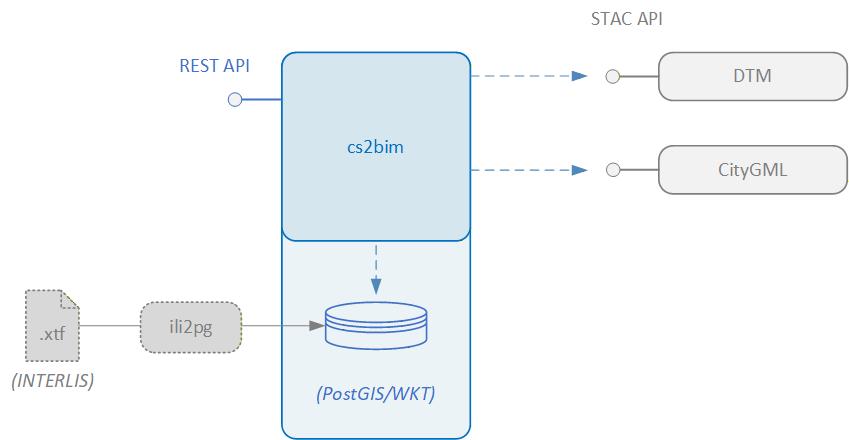
| Component | Description |
|---|---|
| cs2bim | Main component to transform feature types into IFC instances. Including transformation algorithms, IFC serialisation, service task management etc. |
| PostGIS/WKT | Database holding the GIS feature types. In current state, this is a PostGIS database. The component cs2bim has a postgres connection to the database. |
| DTM | Data store with Digital Terrain Model data. DTM data is expected in format XYZ. The cs2bim component gets the DTM data over a STAC API request. |
| CityGML | Data store with CityGML data. CityGML data is expected in version 2 of CityGML. The cs2bim component gets the CityGML data over a STAC API request. |
| REST API | REST API to interact with cs2bim: Start processing, get status of processing, get generated IFC file. |
| ili2pg | External component to transform INTERLIS data into PostGIS. This must be done as a standalone pre process. |
The following architectural enhancements are already being discussed and proposed as potential next steps for the further development and improvement of the service:
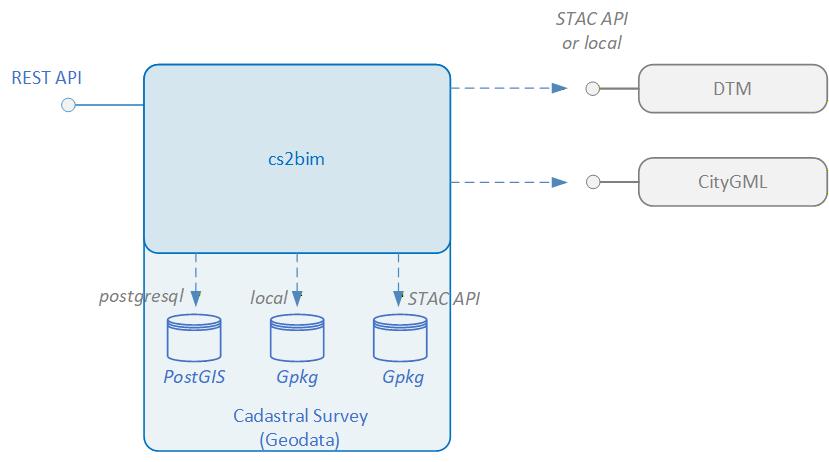
- Geopackage as additional data source format for GIS feature types.
- Geopackage files could be stored locally (on the server) or could be accessed via STAC API
- DMT files stored locally (on the server)
- CityGML files stored locally (on the server)
These improvements would simplify the “local” execution of the service as a “standalone” application, as originally intended.
3.1.2 Internal
3.1.2.1 Services
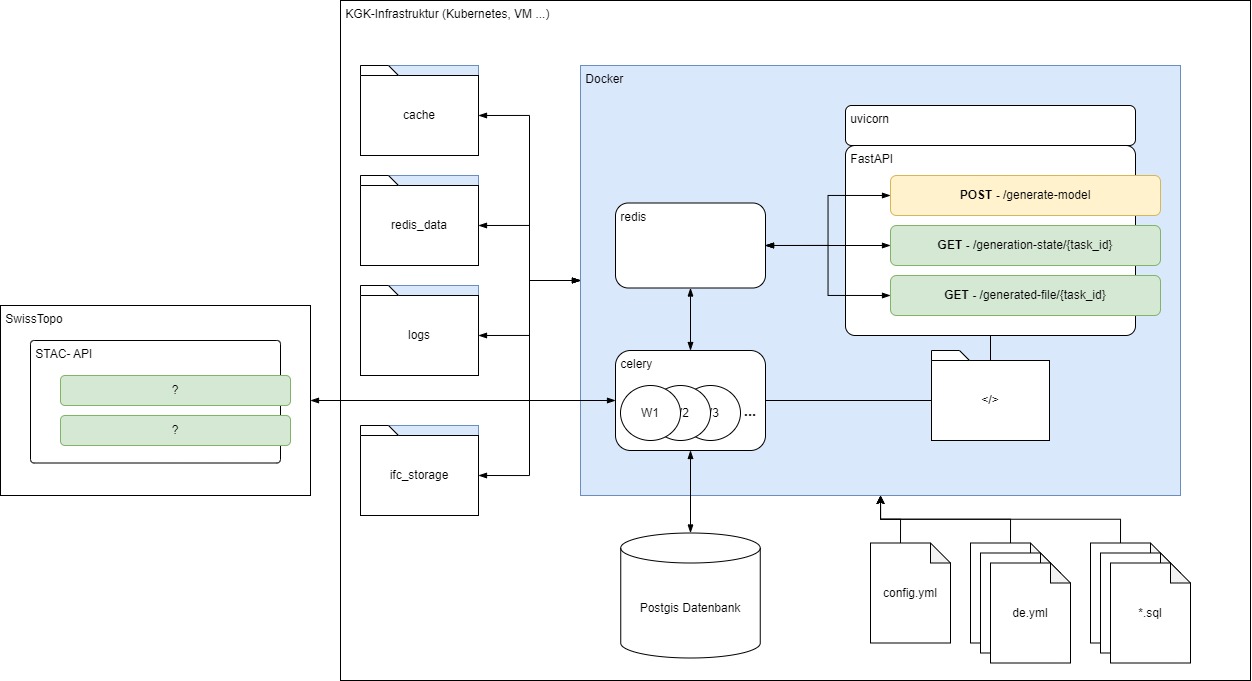
The system architecture is set up using three Docker services.
The api and worker services are built from a custom Docker image based on python:3.10, which contains the application code base and all required dependencies. Both services share the same image but use different entry points. The redis service is created using the standard redis:7 image.
3.1.2.1.1 api
The entry point for this service is the api.app module. It is responsible for routing user requests. There are three endpoints that let the user interact with the application:
POST /generate-model– triggers the generation of an IFC model. Returns atask_idthat can be used to track progress and retrieve the result.GET /generation-state/{task_id}– returns the current state of a generation task.GET /generated-file/{task_id}– returns the generated IFC file once the task is completed.
The service uses FastAPI as the web framework and Uvicorn as the ASGI server to host it.
3.1.2.1.2 worker
The entry point for the worker service is the worker.app module. The service runs a Celery instance that manages and executes IFC model generation tasks. It connects to the required data sources (PostGIS database and SwissTopo STAC API) that provide the data needed for model generation.
3.1.2.1.3 redis
The redis service serves two purposes: as the message broker for the worker service (managing task queues between api and worker) and as the cache management layer, tracking which files are cached and whether cached files need to be refreshed.
3.1.3 Docker Volumes
To store data produced during run-time, the docker-compose file defines four Docker volumes:
- redis_data – persists all data stored in Redis. Prevents data loss on service rebuilds.
- ifc – stores generated IFC files.
- logs – stores log files for the api and worker services.
- cache – stores cached data fetched from external data sources.
3.1.4 Volume Mappings
All configurable files are mapped from the host machine into the containers. This includes translation files (i18n), SQL query files, and the application configuration (config.yml). This way they can be easily edited without rebuilding the containers.